01/08/2025

Via privata Molina 80/7 – 80/9, Vignate (MI)

02 95361055

info@fitex.it

Those who sew know: all scissors are the same. A good tailoring scissor can make the difference between a clean, precise cut and one that ruins the fabric. For this reason, choosing the right model is not a detail, but an essential step in working with precision, speed and safety.
In this guide we find out what are the key features to evaluate when buying professional tailoring scissors and how to tell if you are really using the right tool.
The cure of
Andrea Ferroli
Nadia Leonarduzzi
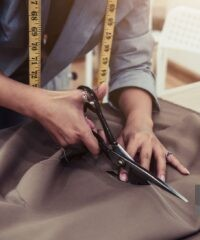
Because cutting well means sewing better. Scissors are a natural extension of the tailor’s hand and should offer control, stability, precision. An unsuitable tool can cause faulty cutting, tears in the fabric, wasted material, and, in the long run, even fatigue of the hand itself.
Professional scissors ensure consistent and long-lasting results, while also guaranteeing maximum comfort in use, whether in industrial or craft sewing regardless of whether the work involves multiple layers rather than the use of technical fabrics, considering even repetitive cuts.
What are the 5 key characteristics to evaluate when choosing tailoring scissors? Let’s look at them together.
The best tailoring scissors are made of stainless steel or carbon steel. The former is rust-resistant and easy to sharpen; the latter keeps the edge longer but requires careful and constant maintenance.
A well-sharpened scissor cuts cleanly through even multiple layers. The best models are hand-sharpened and have a slightly convex edge.
Long, straight blades ranging from 6 to 12 inches offer greater versatility. The longer ones are ideal for clean, wide cuts, while the short ones are more suitable for detailed work or on curved contours.
Essential for working long hours without fatigue. The best handles should be comfortable, non-slip and well balanced against the weight of the blade.
Depending on the material to be processed, one can choose models that are sturdier, in the case of heavy fabrics, lightweight, for delicate fabrics, or more specific with respect to the type of cutting to be done, such as finishing or zig-zag scissors.
Buying a good professional tailoring scissors should be considered with a real investment in the quality of one’s work, both from a point of view of use and the expected end result. A professional tool, if well maintained, can last for decades, offering clean cuts, less physical effort and greater satisfaction.
Fitex selects professional models designed to meet the needs of tailors, workshops and textile companies, with an eye on durability and ergonomics.
A quality scissor, if well maintained, can last a long time and provide consistent performance. It is important to use it only for cutting fabric, avoiding materials such as paper or plastic that can ruin the sharpness of the blades.
After each use, it is a good idea to clean the tool with a dry cloth to remove dust and debris. When not in use, it is advisable to store it in a protective case or dedicated stand, away from moisture or heat sources. When the wire starts to lose effectiveness, it is always best to have it sharpened by a professional to prolong its useful life.
The right scissor accompanies you on every project: precise, reliable, ready to use. Choosing it carefully means respecting your work and getting results that live up to expectations.
Discover also our selection of tools for professional tailoring


Every day, a promotion on an item we have in stock: join our mailing list and take advantage of the benefits!
Already know which item you need?
Order it directly from our app, available for Android and iOS.