01/08/2025

Via privata Molina 80/7 – 80/9, Vignate (MI)

02 95361055

info@fitex.it

Industrial fabric cutters are an important innovation in the textile industry because they improve productivity, reduce waste and ensure high-quality cuts. Because of their robustness, precision, and ability to handle a wide range of materials, they have become an indispensable tool for companies in large-scale production and creative industries that require advanced textile processing.
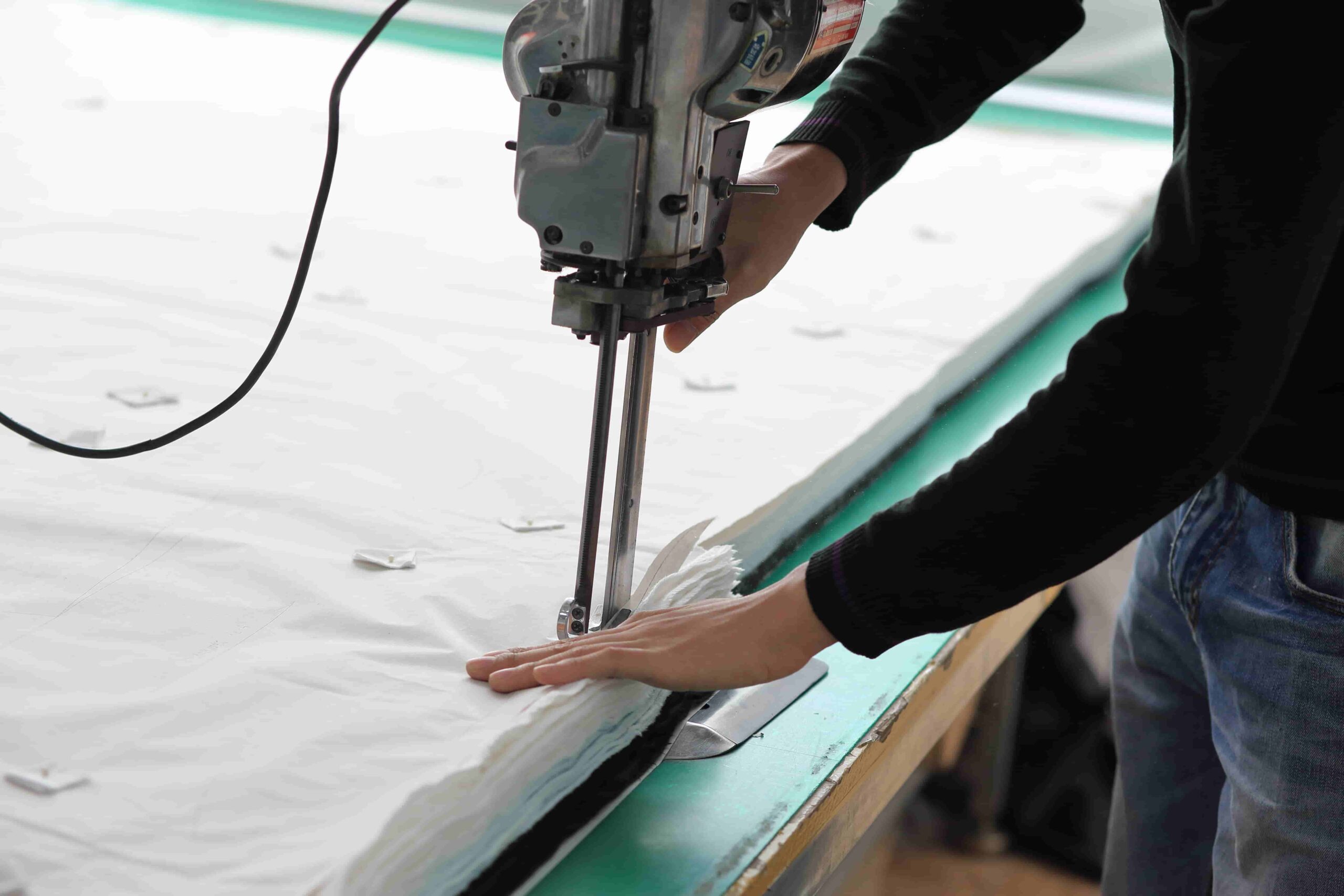
Fundamental to the textile industry, industrial fabric cutters are tools designed specifically to handle large volumes of textile material with precision and speed. Thus, they are machines used primarily in garment factories and are characterized by their ability to cut through many layers of fabric simultaneously, which results in high time savings and increased production efficiency.
The operation of an industrial cutter can vary by model and manufacturer, but generally these are machines that mount a sharp blade on a moving arm or automated system, which allows it to move up and down along a cutting table. The blade can be operated manually or through an automated system, depending on the complexity and needs of production.
One of the distinguishing features of industrial cutters is the ability to handle fabrics of different types and thicknesses, from lighter fabrics (cotton, silk and similar), to heavier materials, such as denim and leather. The machine also allows adjustment of blade pressure and cutting speed to best suit any type of material, ensuring clean, even cuts without the slightest damage. Precisely because they work with minimal margin for error, they are very important pieces of equipment within the production process, as they allow a significant reduction in waste as well as overall costs.
The practical applications of industrial cutters in the textile industry are diverse. They are used to prepare cut-to-length fabrics for the production of garments, accessories, bedding, and upholstery fabrics. Their versatility also makes them ideal for quilting and patchwork work, where precision in cutting complex and detailed pieces is extremely necessary.
Industrial fabric cutters are divided into several types, each designed to meet specific cutting needs. Vertical cutters are among the most common and are used to cut large amounts of overlapping fabric quickly and accurately, particularly materials of a certain thickness. Rotary cutters, on the other hand, use a circular blade that rotates as it moves over the fabric, allowing for long, continuous cuts, including curved or shaped cuts.
Band saws work similarly to the band saws used in carpentry. They have a continuous ribbon blade that moves up and down and allows intricate and detailed cuts on a wide range of materials, including heavier materials. Straight-blade cutters, which are very useful in intensive production, offer reliability for simple, straight cuts and are characterized by their sturdiness.
Technologically more advanced, waterjet cutters use a high-pressure water jet to cut fabrics without generating heat, preventing damage to technical and composite materials. Laser cutters, on the other hand, take advantage of a laser beam to achieve extremely precise cuts, perfect for materials that require sealed edges and avoid fraying, as may be the case when dealing with special fabrics, such as synthetics. The same goes for ultrasonic cutters, which use high-frequency vibrations to make absolutely precise cuts.
Similar to their predecessors in terms of their intended use, but falling squarely within the realm of numerical control (CNC) machinery, plotter cutters offer exceptional versatility because they allow complex cuts and detailed designs to be programmed, making them ideal for custom production and prototyping.
There are also special models that reverse the concept of cutting from what has been discussed so far, namely moving table cutters, in which it is the work table that moves, while the blade remains fixed. A system that allows large pieces of fabric to be cut without moving them, with beneficial results in terms of saving time in processing.
Finally, automatic cutters, fully automated machines that can be programmed to perform complex cuts on a large scale, with advanced fabric management systems that make them perfect for industrial production at high standards of quality and speed.
The choice of industrial cutter depends on the specific needs of production, the type of fabric to be processed, and the requirements for precision and speed of cutting. Each type offers unique advantages, helping to optimize efficiency, reduce waste and ensure high-quality cuts in different areas of textile production.
In order to best orient yourself, given the vast number of models on the market, we recommend that you contact a reliable and experienced manufacturer or retailer in the field. This way you will be able to receive proper advice and all the necessary assistance in choosing the rotary cutter blade best suited to your needs and business goals.
In this regard, we at Fitex have specialized in the trade and production of spare parts, mechanical parts, accessories and complex solutions for the textile industry for over 40 years.
With a stock of more than 50 thousand items, in our catalog you can choose from a wide range of rotary cutter blades of the best brands, able to guarantee a clean, accurate and clean cut on all types of material, with always flawless results.
Our strengths, particularly appreciated in the market, are quick delivery, advanced technical advice and total customer support.
Contact us directly to request the ergonomic sewing chair model you are looking for and to receive a personalized quote and dedicated assistance.
Andrea Ferroli
Nadia Leonarduzzi


Every day, a promotion on an item we have in stock: join our mailing list and take advantage of the benefits!
Already know which item you need?
Order it directly from our app, available for Android and iOS.